Stop-and-go city traffic: how to drive smoothly, use less fuel and stay calm
By the TripRank team · 4 November 2026 · 6 min read
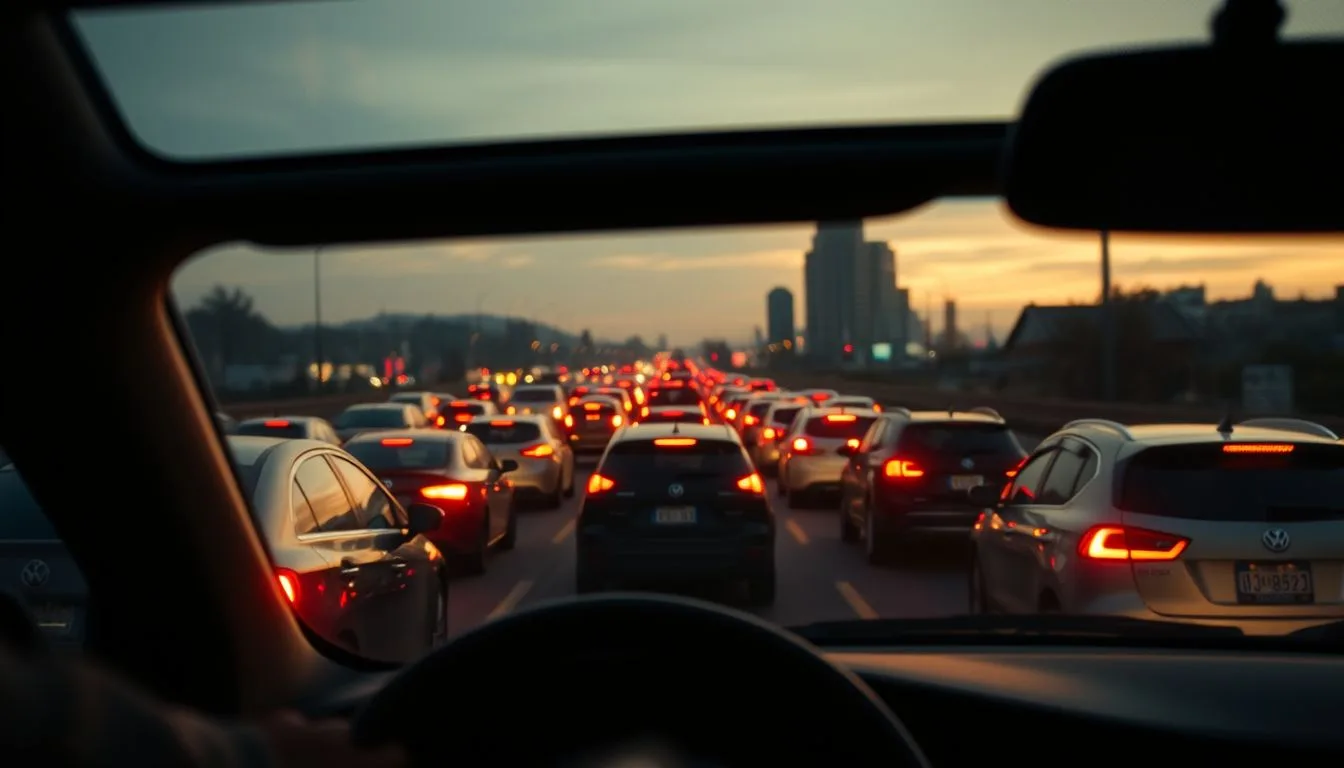
In heavy traffic the car spends its life accelerating a little, braking a little and repeating it. Every needless stop is energy you paid for and then threw away as heat in the brakes. You cannot clear the road, but you can change how you move through it.
Leave a gap and roll
The biggest single habit is the space in front of you. A decent gap lets you ease off the accelerator and roll as the queue moves, instead of stopping and starting. Rolling at walking pace uses less fuel than a full stop followed by a fresh pull-away, and it is easier on the clutch and brakes. Do not leave so much space that others cut in constantly; a car length or two at crawling speed is usually enough.
Look two or three cars ahead
Brake lights several cars ahead tell you the queue is about to slow before the car in front reacts. Lifting early means a gentle slowdown instead of a hard brake. It is the same idea as in our smooth driving guide, and it is the main reason a calm driver in the same traffic burns less fuel.
Be gentle with the pedals
- Accelerate softly from a stop. A hard launch to close a small gap gains nothing.
- Manual cars: avoid riding the clutch or holding the car on a slope with it. Use the handbrake or hill-hold if your car has it.
- Automatic cars: let the car creep where it can, and use the brake gently.
- Electric and hybrid cars: traffic is where regenerative braking helps most. See our guide on electric car range.
Long waits: should you switch off?
If you will be stopped for a long time, such as at a long signal or a blocked road, switching the engine off saves fuel that would otherwise be spent going nowhere. Many modern cars have an automatic stop-start system that does this for you. For a short pause, leave the engine running. Check your manual if you are unsure, and only switch off when it is safe and the car is not in the flow of moving traffic.
Keep the load low
- Remove heavy things you do not need from the boot.
- Keep tyres at the right pressure, as in our tyre guide.
- Set the air conditioning to a comfortable level rather than the coldest setting.
Keep your head
Aggressive lane-hopping in a jam rarely saves more than a minute or two, and it adds risk and stress. Breathe, put on something calming and accept the pace. A relaxed driver brakes less, and it shows in the numbers.
See it in TripRank
Record a rush-hour commute and look at the hard-brake marks and the driving score. Then try the same route using the habits above. Because the route is the same, the difference is yours, not the road's. The cost per km guide shows how to put a rupee figure on it.
Download TripRank and compare two commutes.
Frequently asked questions
Does stop-and-go traffic use more fuel?
Yes. Repeated stopping and accelerating wastes energy compared with steady driving. Leaving a gap and rolling instead of stopping reduces it.
Should I switch off the engine at a long red light?
For long waits, yes, it saves fuel. For short pauses leave it running. Many modern cars have automatic stop-start that does this for you.
Is it bad to hold the car on a slope with the clutch?
Yes. It wears the clutch. Use the handbrake or hill-hold instead.
How can I measure the improvement?
Record the same commute twice with TripRank, before and after changing your habits, and compare the hard-brake count, score and fuel cost per km.
 Car speedometer app: how to pick an accurate GPS speed app (and what to avoid)
 Car mileage tracker and logbook: how to log your trips automatically
 Car acceleration app: how to measure 0 to 100 km/h with your phone (safely)